Word on Genetic Testing
Genetic testing should clearly be regarded as an invaluable tool for any conscientious breeder, with
some caveats, however. It could be said that canine genetic testing is a field in its infancy and
that, as such, the information we have provided to you is for your consideration only. We cannot
guarantee the results of any genetic test beyond the facts that we have ordered the tests, submitted
the DNA in good conscience, and offered you complete transparency in viewing the results that we
have received, in their entirety. It is the buyer’s responsibility to familiarize themselves with
the results and to contact their licensed veterinarian and/or the testing company for clarification
of questions or concerns. At any time, you are welcome and encouraged to review the genetic testing
results for our parent dogs and to share them. We are also eager to answer questions and offer
insight as we may. Testing is a top priority for us and we are always endeavoring to learn more and
happy to share what we’ve learned. We are not veterinarians or scientists, but we are ultimately
concerned with making sure that we’ve covered our bases with people who are counting on us. We are
also passionate about excelling in producing dogs of increasing quality at a reasonable price point.
We have been privy to, albeit rare, accounts where, for various reasons, test results are simply
found to be inaccurate. We have done our due diligence in thoughtfully matching dogs which we feel
are mutually compatible to produce healthy, happy puppies, but beyond that, we cannot be held
responsible for the veracity of genetic tests.
We are committed to thoroughly screening our dogs and make it a priority to ensure that your puppy
will be of the highest quality.
CDDY Statement
Regarding the CDDY and the CDPA genes:
Like all responsible doodle breeders,we take a particular focus on weeding out specific,
breed-relevant genetic diseases, including PRA, vWD, DM, and NEwS. As such, we are supremely
confident in the genetics of your puppy, with one small disclaimer…
In 2017
, a mutation in a gene that increases the risk factors for intervertebral disc disease (IVDD) was
discovered by the University of California, Davis genetics laboratory. IVDD is a condition in which
the discs that cushion the spine are prone to damage. The disease is categorized by five stages
ranging in severity from disc inflammation that requires bed rest and anti-inflammatory drugs, all
the way to disc herniation and neurological damage that require surgery.
In 2019
, it became possible to purchase testing kits for this mutation, which previously existed seemingly,
by and large, off the radar of most poodle and doodle breeders, as IVDD is generally a rare disease
in these dogs. With the advent of testing, however, it became clear, practically overnight, that an
overwhelming majority of poodles (over 80% in some estimations) carry one or two copies of the CDDY
gene.
After speaking to our family vet and other ethical breeders, doing our due diligence to learn as
much as possible about this gene, speaking with genetic counselors from Embark, as well as UC Davis
Veterinary Genetics Laboratory (the discoverers of the gene who designed the test for it), and
comparing our practices with the breeders that we’ve encountered that actually elect to address the
subject at all, which is very, very few, we have come to accept the following:
The gene increases risk for developing IVDD, though it does not ensure a diagnosis or cause IVDD. In
fact, after speaking to genetic counselors and veterinarians, it has been difficult for us to gain a
wholly reliable understanding of what the baseline even is for doodle dogs. Without a clear
understanding of what the baseline risk is in the bernedoodle population, we really don’t know what
we’re looking at. Our family vet said that when she sees, on occasion, dogs with IVDD, poodles and
doodles are not generally the dogs that are troubled with the diagnosis. It seems that more often,
it is dogs who display shorter legs and longer backs, relative to the length of their legs, that
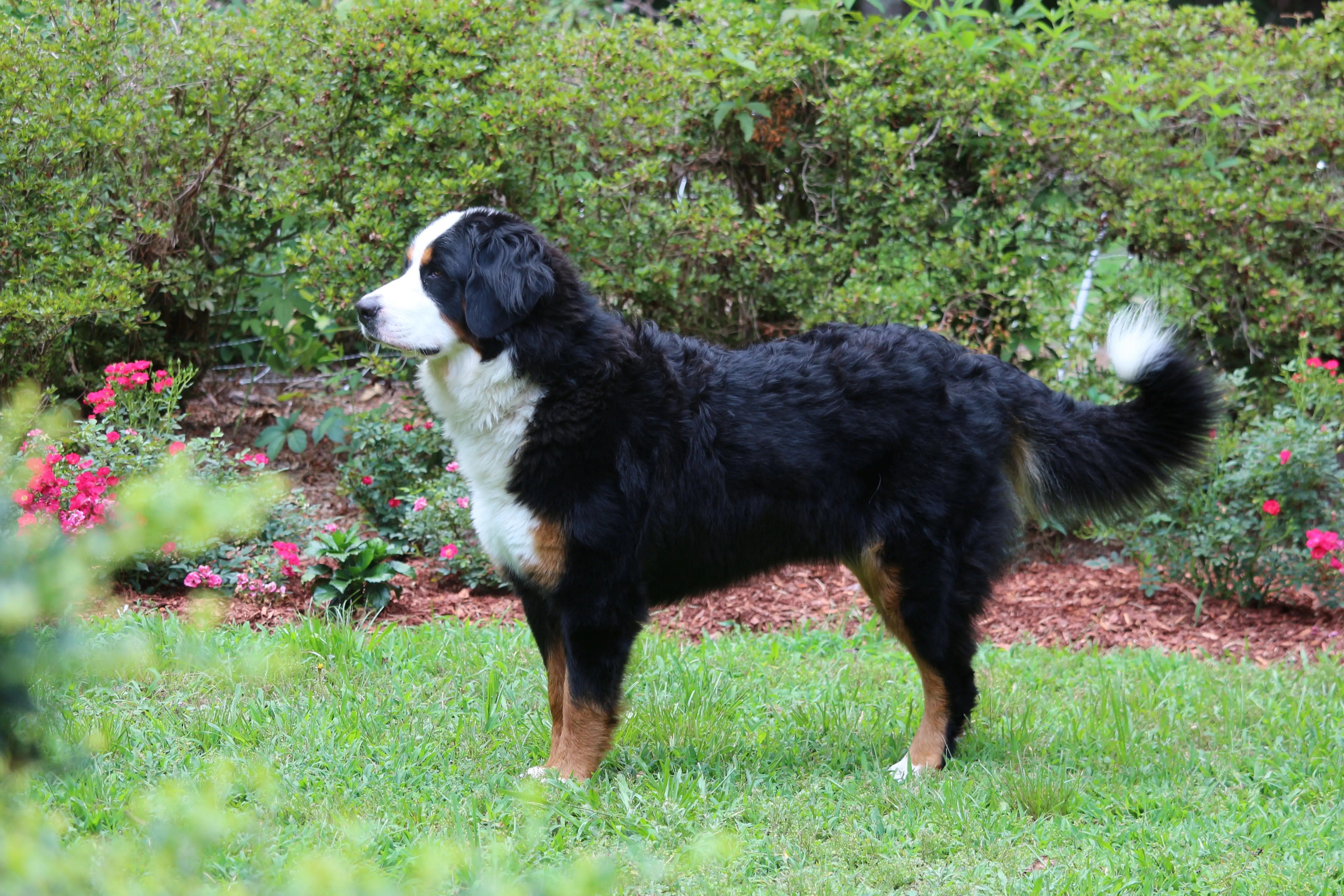
have higher rates of IVDD. We carefully evaluate the structure of our parent dogs and start with
dogs who are proportional, with long legs and a square frame, not the “low-rider” body structure as
seen in dogs like corgis, dachshunds, and basset hounds.
UC Davis’s website suggests a 57% rate of inheritance of this gene in the miniature poodle
population. Embark states that 48% of miniature poodles will carry one copy of the gene and an
additional 38% will carry two copies. Thus, all doodle dogs (especially earlier generations) are at
an increased risk for carrying the gene, though diagnoses of IVDD in goldendoodles, bernedoodles,
and poodles seem to be relatively low.
The test for CDDY/IVDD is a provisional test only, as well as a linkage test, which are not as
predictive as the direct assays run for most other genetic tests.
It is uncalled for to remove otherwise healthy dogs from the gene pool simply because they carry the
gene, as the decision to remove them would reduce genetic diversity and come with risks of its own.
Rather, it’s been suggested to let the CDDY be the tie breaker between two otherwise comparable
breeding dogs, all other traits considered. We have been dedicated to breeding this out of our dogs
over time due to reasons of principle and just to error on the side of abundant caution.
Ironically enough, however, it may be worth adding that some breeders we have spoken with profess to
choose to retain a single copy of the gene in their breeding programs because of a preference for
its potential influences on body style. I’ve heard it said that dogs that are completely CDDY clear
can exhibit a taller, “leggy” look, which is not preferred. I bring this up only as food for
thought… “Damned if you do, damned if you don’t.”
It’s also worthwhile to note that the genetic testing companies that recommend specific panels for
breed relevant diseases (including Embark, Paw Print, GenSol, and Animal Genetics, to name a few) as
well as Good Dog, a site that offers guidelines on how to judge breeders’ practices, do not
highlight CDDY as a relevant test in their breed-specific panels for poodles, bernese mountain dogs,
or bernedoodles. We do a more thorough screening of our dogs, which is why we even know it’s there
to begin with. Knowing it’s there has forced us to stop and thoroughly consider what that might
mean, particularly because if we offer transparency in viewing our genetics, the issue is bound to
come up with discerning customers.
To further convolute the matter of CDDY, is the CPDA gene, which is where we draw a hard line.
Chondrodysplasia (CDPA) is the gene responsible for short legs, as seen in breeds such as
dachshunds, basset hounds, and corgis. My children love them; we call them “stubbies.” They make for
squatty, adorable puppies, but I do not prefer the body style when they mature. Additionally, and
more importantly, when the CDPA gene is paired with the CDDY gene, the resultant dogs show a
markedly chondrodystrophic appearance with short legs and an elongated torso and have a higher risk
of being diagnosed with IVDD. As such, we do not breed dogs with the CDPA gene, ever.
The bottom line is, it is our stance, presently, that the relatively recently emerging concerns
about CDDY will prove over time to be “much ado about nothing” for doodle breeders. Until then, it
seems to me that all of us who love these dogs are in this boat together as we wait to see what time
will tell on this topic.
As we learn more about the role genetics may play in predicting outcomes for IVDD, it is much more
important to acknowledge that this disease can also be very much influenced by lifestyle factors. As
such, as part of the due diligence in caring for these dogs (and really, any dog), it’s always a
best practice and an owner’s responsibility to:
- Maintain dogs at a healthy weight throughout their life span.
-
Provide appropriate exercise, thus keeping them fit and active while wisely limiting high impact
activities.
-
Provide step stairs for dogs that will be climbing up on beds and furniture in order to minimize
a lifetime of stress on the spine.
If you have questions or concerns about this information, please talk to us about them.